Engineering High-Capacity Water Management for Emergency Infrastructure in Rwanda
Fire and rescue stations, emergency response centers, and ambulance depots across Rwanda—from central stations in Kigali to regional district hubs—operate under extreme daily operational stresses. Emergency service bays experience constant wash-downs, heavy appliance transit (heavy-duty fire trucks and rescue vehicles), and localized surface water pooling during heavy tropical downpours. For broader infrastructure drainage benchmarks, explore our Surface & Channel Drainage Systems Hub.
Without high-capacity channel drainage, emergency bays suffer from standing water, chemical runoff, slipping hazards, and structural erosion around bay thresholds. Standard domestic or light commercial drains fail rapidly under heavy wheel loads and high peak flow rates, compromising response times and equipment safety.
This technical guide provides civil engineers, municipal authorities, architects, and main contractors in Rwanda with technical specifications for ACO Channel Drainage Systems engineered specifically for heavy-vehicle transit and rapid water evacuation.
1. High Load Class Capabilities: Withstanding Heavy Emergency Vehicles
Fire engines and heavy rescue tankers exert immense point loads and dynamic braking forces on appliance bay thresholds and apron pavements.
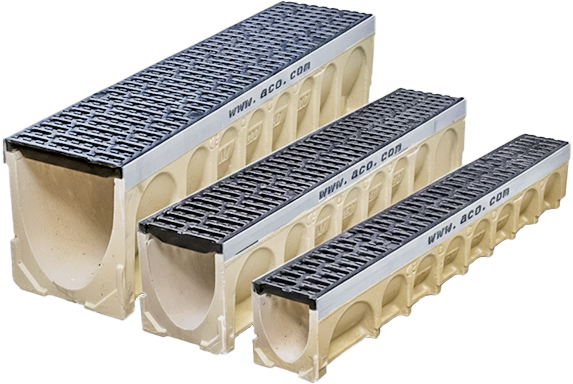
What to Specify: ACO Heavy-Duty Polymer Concrete Channels with cast iron or stainless steel ductile gratings rated to Load Class D400 to F900.
Technical Specs: Engineered to withstand wheel loads from 400 kN up to 900 kN; features integrated locking mechanisms that prevent grating displacement during high-speed emergency deployments. View ACO Drainage Channels
2. High Hydraulic Capacity & Rapid Evacuation
Appliance wash-downs, foam discharge testing, and intense tropical storm runoff require immediate, uninterrupted water intake to maintain clear, hazard-free aprons.
What to Specify: ACO Monoblock & Modular Slotted Channels with V-shaped smooth internal profiles.
Technical Specs: Smooth inner surface maximizes hydraulic flow velocity and self-cleansing action; prevents silt and debris buildup inside the channel, ensuring full capacity during peak rain events.
3. Chemical & Hydrocarbon Resistance
Emergency depots handle diesel fuel, hydraulic fluids, oils, and firefighting foam agents during routine maintenance and washing operations.
What to Specify: ACO Polymer Concrete Drainage Channels paired with integrated oil and silt interceptors.
Technical Specs: Non-porous polymer concrete structure resists aggressive chemicals, oils, and road salts; prevents hazardous fluids from leaking into surrounding soil structures or municipal stormwater networks.
4. Low-Profile Threshold Safety: Anti-Slip & Flush Surface Profiles
Smooth transitions across bay entrances are vital to prevent tripping hazards for personnel and ensure smooth vehicle entry and exit.
What to Specify: ACO Heelguard & Anti-Slip Ductile Iron Gratings installed perfectly flush with surrounding concrete or asphalt pavements.
Technical Specs: Narrow grating slots prevent footwear trapping while maximizing surface water capture; anti-corrosive protective coatings ensure long service life in wet environments.
Equip Emergency Response Bays with High-Performance Drainage
Ensuring emergency service stations remain functional, safe, and free from standing water requires specialized heavy-duty surface drainage infrastructure.
HOMNA is an authorized supplier and technical distributor of ACO Surface Drainage Solutions across Rwanda. Our engineering team provides complete hydraulic calculations, channel sizing, CAD installation drawings, and certified site supervision.
Get Technical Submittals and Pricing for Your Emergency Infrastructure Project:
East Africa Regional Office: 2 KG 125 St, Remera, Gasabo, Kigali
Phone: +250 792 402 072 / +250 796 603 500
Email: info@homnaltd.com
Website: rwanda.homnaltd.com
Need Technical Guidance for Your Next Project?
Our certified engineering team provides on-site technical specification support across Rwanda.