Specification decisions made early in a commercial building project determine how that structure performs for the next twenty, thirty, or fifty years. Get them right and the building holds up under load, stays watertight, drains efficiently, and maintains its finish. Get them wrong and you are managing callbacks, remediation costs, and reputational damage long after the project closes.
This guide is written for engineers and architects working on commercial building projects in Rwanda and Uganda. It walks through the core systems that belong on every commercial build, what to specify, where it applies, and what to look for in each category.
Start at the Foundation: Concrete Technology and Admixture Systems
The concrete mix design is the first specification decision that affects everything downstream. On commercial projects, where you are dealing with large volume pours, varying curing conditions, and structural elements that carry significant loads, standard concrete is rarely enough.
What to specify and why
Superplasticizers like Sika ViscoCrete 3088 high-performance superplasticizer and Sika ViscoCrete 20 HE high-early-strength admixture give high workability without increasing the water-cement ratio, which is critical for maintaining compressive strength targets while keeping placement manageable on large floor slabs and columns.
For time-sensitive pours where early strength gain matters, say, a transfer slab or a post-tensioned deck, accelerating admixtures like Sika Rapid 2 reduce the waiting period before formwork can be struck, keeping the programme on track without compromising structural performance.
Waterproofing admixtures like Sika Plastocrete N and SikaControl 110 WT work within the concrete matrix itself, reducing permeability at the mix stage. On basement walls and ground-bearing slabs, this is your first line of defense against moisture ingress, and it costs a fraction of remedial waterproofing applied after the fact.
Curing compounds like Sika Antisol 181 and Sika Antisol E retain moisture at the slab surface during the critical early hydration period, preventing plastic shrinkage cracking, a common problem on exposed commercial floor slabs in East Africa's variable climate. View Sika Concrete Admixtures Solutions
The Waterproofing Specification: Matching the System to the Exposure
Waterproofing on a commercial building is a layered decision. Different parts of the structure face different exposure conditions, and the system needs to match.
Basement and below-grade structures
For basement walls and slabs in direct contact with the ground, a crystalline waterproofing system is the most durable long-term specification. Sikalite crystalline waterproofing admixture, added to the concrete mix, generates insoluble crystals within the concrete matrix that permanently block capillary pathways, even under hydrostatic pressure. This is a set-and-forget solution that becomes part of the structure itself.
Where a surface-applied system is required, on existing concrete or blockwork, cementitious waterproofing coatings like SikaTop Seal-107 waterproofing slurry membrane provide a reliable, proven barrier. For higher hydrostatic pressure conditions, SikaTop 501 Seal flexible waterproofing slurry and SikaTop 599 Seal elastomeric crack-bridging membrane offer enhanced resistance with flexible, crack-bridging performance.
For construction joints in basement walls, the points most vulnerable to water ingress, specify SikaSwell S-2 hydrophilic joint waterstop profile, a hydrophilic waterstop profile that expands on contact with water to form a permanent seal at the joint.
Roofs and podium decks
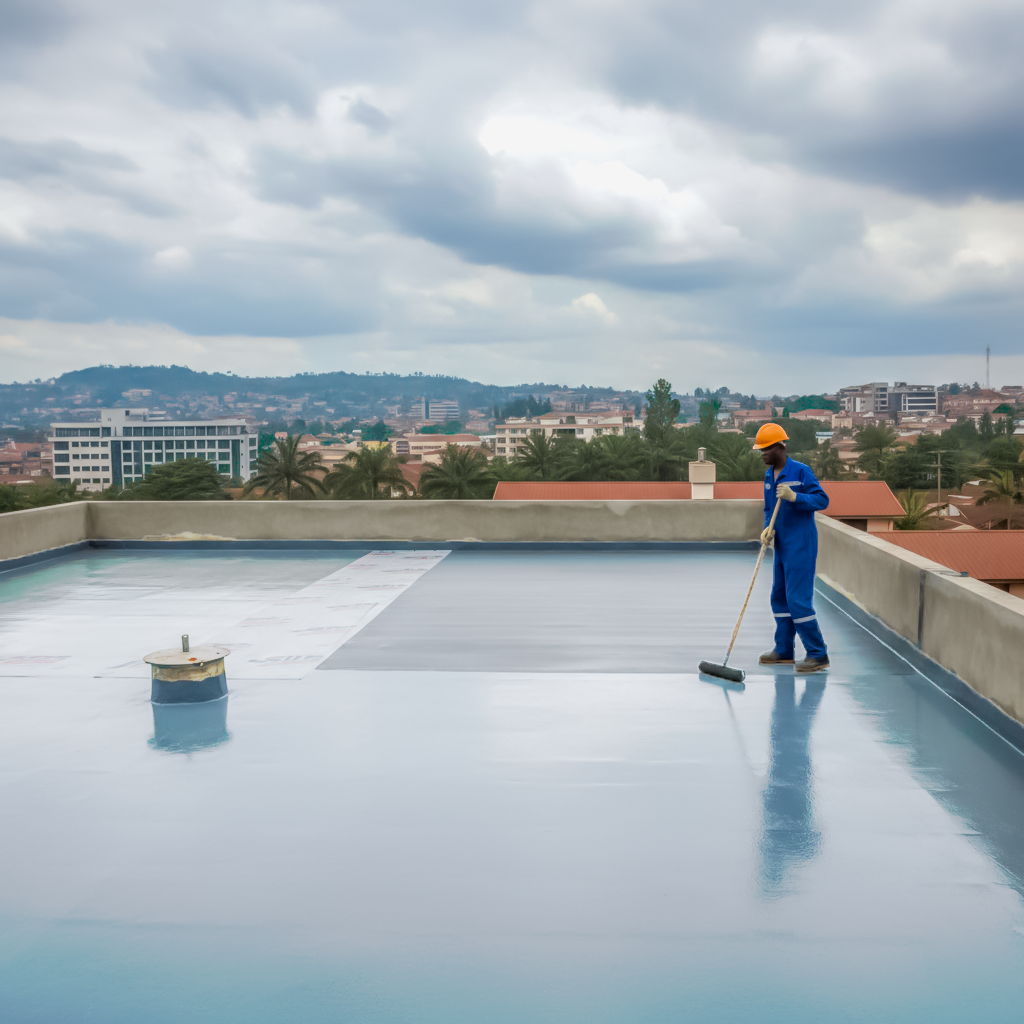
On flat roofs and exposed podium slabs, thermal movement and UV exposure are the main challenges. The SikaShield APP torch-applied waterproofing membrane is a torch-applied bituminous membrane system that delivers robust waterproofing with excellent resistance to both UV degradation and thermal cycling, appropriate for commercial roof areas that carry foot traffic or mechanical plant.
For green roof assemblies, increasingly common on commercial buildings in Kigali, HOMNA supplies a complete Sika Green Roof System including drainage layers, geotextile filter fabrics, and protection boards that work together as an engineered system rather than a collection of individual layers. View Sika Waterproofing Systems
Flooring Systems: Specifying for Use, Not Just Appearance
Commercial buildings carry a wide range of floor use conditions, office lobbies, retail spaces, back-of-house areas, car parks, and plant rooms, and each one demands a different flooring specification.
Office, retail, and public areas
For finished concrete floors in office and retail environments, SikaFloor 161 epoxy primer and coating is a solvent-free epoxy coating that provides a clean, durable, low-maintenance surface. Where a higher-build decorative finish is required, SikaFloor 264 self-smoothing epoxy floor delivers a self-smoothing epoxy layer with excellent aesthetic quality and resistance to light traffic and cleaning chemicals.
Car parks and vehicle access areas
Car park decks are among the most demanding floor environments in any commercial building. They face vehicle loads, tyre abrasion, oil contamination, de-icing salts, and constant moisture exposure. The correct specification here is a polyurethane traffic coating system, SikaDur and SikaFloor systems engineered specifically for vehicular traffic, combined with proper joint sealing and drainage design.
Plant rooms and back-of-house
Mechanical plant rooms, loading bays, and back-of-house service areas benefit from high-build epoxy or polyurethane systems that resist chemical spills, heavy trolley traffic, and frequent cleaning cycles. Sika Ucrete heavy-duty polyurethane concrete flooring, a polyurethane concrete system, is the specification of choice for environments where thermal shock, chemical aggression, and heavy point loads combine. View Sika Industrial Flooring Solutions
Drainage Design: Getting Water Off and Away from the Building
A drainage specification that is undersized, incorrectly graded, or poorly detailed creates problems that are expensive to fix after construction. On commercial buildings, drainage design touches multiple zones, the roof, the car park, the entrance areas, the plant room, and the public realm around the building perimeter.
Surface and channel drainage
For pedestrian and vehicle areas around commercial buildings, ACO channel drainage systems, including the ACO Drain Monoblock RD monolithic heavy-duty drainage channel and ACO Drain Qmax Neo 300/600 high-capacity slot drainage, provide reliable surface water collection with load ratings appropriate for the access class of each zone. Stainless steel grating options are available for areas where aesthetics matter, such as building entrances and landscaped courts.
Roof drainage
Flat roofs on commercial buildings require properly engineered ACO Roof Drain rainwater outlet outlets that can handle peak rainfall events without backing up. These are specified with appropriate outlet sizes and overflow provisions based on the roof area and the local rainfall intensity data for Kigali or Kampala.
Parking deck drainage
Multi-storey car parks require drainage systems that can handle both surface runoff and incidental fuel or oil spills. ACO Parkdeck channel systems are engineered specifically for this environment, with appropriate load ratings, chemical resistance, and integration with oil separators where required by local environmental regulations.
Grease and oil separation
Where a commercial building includes a kitchen, in a hotel, a restaurant tenancy, or a staff canteen, an ACO Grease Separator is a specification requirement, not an option. Without it, grease accumulation in the drainage system leads to blockages, odour, and potential regulatory non-compliance. View ACO Drainage Solutions
Protective Coatings: Specifying for Long-Term Surface Performance
The coatings specification on a commercial building affects both the long-term protection of the substrate and the maintenance costs the building owner will carry over the life of the asset.
Exterior facades
For exterior masonry and render surfaces, Plascon WeatherGuard exterior acrylic paint is the specification standard for East African conditions, delivering crack-bridging capability, algae and mould resistance, and superior durability against the UV intensity and rainfall patterns of the region.
Where a textured finish is part of the architectural intent, Plascon Archi-Texture Graffiato textured facade coating provides a decorative rendered finish with crack-bridging performance and a broad colour range, suitable for facades where both aesthetics and protection need to be resolved in a single system.
For bare masonry that needs a breathable, invisible treatment before painting, Plascon Brickseal masonry water repellent consolidates the surface and reduces paint consumption without altering the substrate appearance.
Interior walls and ceilings
In office, retail, and common area interiors, Plascon Vinyl Silk washable interior satin paint delivers a washable, subtle sheen finish that holds up well against cleaning and daily contact, appropriate for high-traffic commercial interiors where maintenance ease is a long-term cost consideration.
Steel and metalwork
Structural steel elements, staircases, and metalwork in commercial buildings require proper corrosion protection. Plascon Red Oxide Primer anti-rust foundation provides the anti-rust foundation coat, followed by appropriate topcoats selected for the exposure environment and aesthetic requirement. View Plascon Protective Coatings
Insulation and Building Envelope: Specifying for Comfort and Efficiency
In Rwanda and Uganda's climate, insulation is primarily a thermal and acoustic management tool. On commercial buildings, where energy costs, occupant comfort, and acoustic separation between tenanted spaces are real operational concerns, the insulation specification has a direct impact on the building's long-term performance and running costs.
Roof insulation
Jumbo Chem reflective roof insulation reflects up to 97% of radiant heat, dramatically reducing the load on air conditioning systems and improving thermal comfort across all building types, a practical advantage in Rwanda's climate.
Wall insulation
Jumbo Chem thermal and acoustic wall insulation restricts heat transfer through the building envelope while providing superior acoustic separation, particularly relevant in mixed-use commercial buildings where different tenancies share party walls, or where office floors require controlled acoustic environments.
Pipe insulation
Mechanical services in commercial buildings, chilled water lines, hot water supply, and HVAC distribution systems, benefit from Jumbo Chem preformed pipe insulation to prevent heat gain or loss in transit, protect against condensation, and extend the service life of the pipework.
Expansion Joint Filler
Every commercial building has structural movement joints, and these joints need a filler system that accommodates movement while maintaining the waterproof integrity of the building envelope. Jumbo Chem closed-cell expansion joint filler is chemical-resistant, waterproof, and compatible with cold-applied sealant systems, a reliable specification for movement joints in floors, facades, and roofs. View Jumbo Chem Building Envelope & Insulation
Specify with Confidence. Build with Certainty.
A commercial building project involves hundreds of specification decisions. The ones that matter most are the systems that protect the structure, manage water, carry loads, and maintain their performance year after year. Specifying the right product in the right location, and having it installed by a certified applicator who knows the system, is what turns a good design into a building that performs.
HOMNA supplies and professionally installs all of the systems covered in this guide across Rwanda and Uganda. If you are at specification stage and want technical guidance on the right system for your project conditions, the HOMNA team is available to assist.
Reach us here: Rwanda: 2 KG 125 St, Remera, Gasabo, Kigali | Phone: +250 792 402 072 / +250 796 603 500 | info@homnaltd.com | www.homnaltd.com
Need Technical Guidance for Your Next Project?
Our certified engineering team provides on-site technical specification support across Rwanda.